Photo Essay
- ghooper0
- Jun 7, 2016
- 6 min read

Each day here was an early wake up and a late ending, but there was never a dull moment. The picture shows the site of the electorchaea’s reactor in Copenhagen. This is where I spent a week of my time and it is located on a wastewater treatment facility. Between the archaea and the wastewater this facility did not have the best smell, but you get use to it after a while. You are unable to eat and drink outside so everyone takes lunch at the same time in a building. The work area is small, but somehow we still fit 9 people inside, but that presented a challenge...

That challenge was this small knob. It was the power control knob and when turned only a few degrees it shut down the power to the reactor as well as the computer monitors. This happened twice in only three days, causing about 3 hours of panic because no one had a clue what happened. The second time was much easier only taking about an hour to restart the machine, which gave me a slight break.

This was Manuel's(person in picture) first time on site at the reactor. So he was taught how to control and monitor the reactor using the computer's shown. While he worked and changed different things within the reactor I took data samples off the computer as well as archaea samples from the reactor outside. I did this every 10-15 minutes so my 9 hour day was spent looking at these monitors, then running to measure pH and optical density, then showing Manuel what I had found and then repeat until the reactor was turned off and the day was over.

This was where the Hydrogen was being created, but inside was a small lab setup(next picture) where I could measure pH and optical density of the archaea.

These are the tools I used to measure the pH and optical density of the archaea I collected every 10-15 minutes. I struggled with the time crunch because each test took me about 13 minutes so the first day they kept testing to every 15 minutes, but on the second day they ran an experiment so testing needed it to be done every 10 minutes. This forced me to quicken my pace and I was able to do the testing in a little under 6 minutes. With the remaining time after each test I showed Manuel what I had found and then started over.

After collecting archaea from the reactor (green liquid) I would test optical density by diluting it to a ratio of 1 to 100, arecha to water. Then the machine calculated the rest. While the machine was running I then used the pH strip to find the pH. Wrote down the data I had collected from that as well as the computers and that was one test.
Top Left optical density machine
Bottom Left ph Stip
Right archaea collected from reactor

Here are some pictures to show you kind of what pH and optical density collection looked like.

This is just after a couple hours of data collection.

This is the reactor that holds the archaea and converts the biogas and hydrogen to methane. It should be attached to the grid and creating energy for Denmark by the end of this year, but at the moment the gasses exiting are just being burned.
Left side view of reactor
Right standing on top of the reactor

While the reactor was down there was no data to be collected so during that time Manuel, Hans and I went through and matched the P and ID (piping and instrumentation diagram) to how the reactor was actually set up. Using the tags pictured we found what was there and what was missing, marking up the P and ID as we went so it could be adjusted. We then added new tags to the pieces that were missing them.
Left Hans(left) and Manuel(right) looking for tags and matching Pand ID
Top Right old tags we matched
Top Bottom new tags we added.

Working on the P and ID

After work dinner with everyone.

Funny Story:
My parents decided to try and visit Sweden without their passports. That didn’t work out very well. This is the only picture they got and it’s at the border with the police officer who had to escort them back out. As you can see Beth was smart and brought her passport.

Site Two: Munich
In Munich the days started later and ended earlier, but every day when people began to leave they looked at their watches and realized they had stayed two to three hours over the time they had planned.
I had a really pretty walk to and from work, it was only about 20 minutes so it was a nice walk as long as it didn’t rain, which was very rare.

Some parts of my day are spent in the lab. I am either helping collecting data, being taught how different machines work or filling out tables to be used later. This was my favorite place on this site to work because it was a louder less serious environment and I could work really hands on with the equipment. I learned a ton there as well because when ever I worked on something my mentor/person I was shadowing explained each step and what each part of the process was about.
Top-Mass Spectrometer and Gas chromatography-used to find the amount of methane and CO2 in a given gas sample
Bottom-Some work I did using a program that predicts what will happen in the reactor.
Right- Set up of the lab more desks on other side.

I did a bunch of different things in the area of data collection in the lab. I helped with optical density and pH like in Denmark, but this was much different. I had more high tech machines to calculate pH and other things that before I had read off the computer. I also helped run experiments and other things. One thing that took the most time was using a program that would calculate what the reactor would produce given different inputs. It took me about 4 hours and then next day I came in and found out one of the set values had been incorrect and I had to start over. I then got more things to change and ended up doing about 10 hours of work with this program.
Top- Spreadsheet for data and the program Bottom-Data collected Right- Other lab work
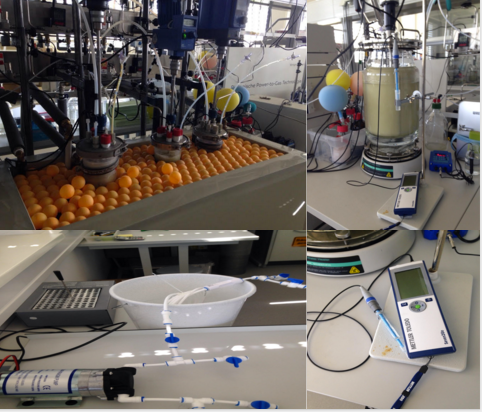
I helped the people working in the lab with many different experiments. Each experiment I helped with was drastically different than the one before it and areas of study changed based on who I was working with. The lab has five different small reactors each studying a different scenario. I would help to test what was happening with in those reactors and what was being produced from them. Another experiment was to find a way to extract the extra water being created by the archaea while keeping the bugs and nutrients and expelling pure water. For this we had to find a way to cool the water enough to be ran through a filter and then rewarm it so the organisms were not harmed.
Top- 4 of the 5 reactors
Bottom left cooling system
Bottom right pH detector

I had my own desk in the office area and spent my time there working on whatever they had for me at that moment. I mostly sorted photos for presentations and grand opening of the reactor, booklets for meetings and sorting/renaming literatury. This was a more quiet environment and the work wasn't as plentiful because I finished things faster than they expected. So in the moments they didn’t have anything I walked to the lab or helped Jana send emails.
Top Left Jana’s desk
Top Right files I was sorting
Bottom Left the typical desk
Bottom Right my desk

At Electrochaea every Wednesday a different person is tasked with making lunch for everyone else in the office and then everyone sits down together and eats for about an hour. It was an awesome way to get to talk and learn more about everyone else and with so many different ethnicities in the office it was a large variety of foods.
One day when I had finished the work they had for me I got to help Doris make the lunch. Everyone laughed about how she was the first to make me cry (I was tasked with cutting the onion)


Comments